OkHenry
okhenry.ai →
A free tool from OkHenry · The 5×5 Method

Design work steps that don’t break.

Most process docs start with “Step 1: do this thing.” That’s the wrong starting point. The Step Execution Canvas is a one-page tool for designing a work step completely — before anyone runs it.

Free PDF · No email required · Ready to print · See a worked example ↓
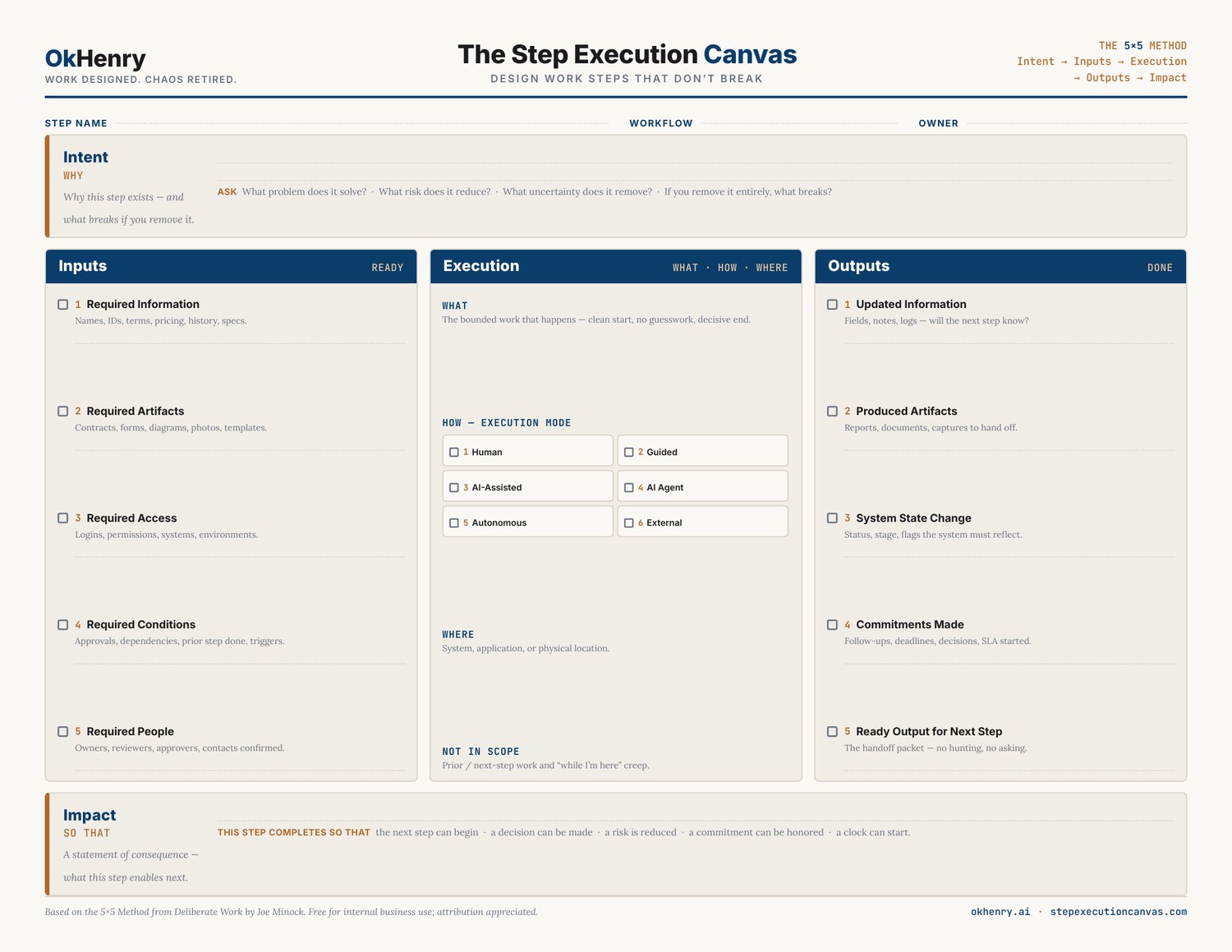
The Canvas The Step Execution Canvas: a one-page layout with Intent at the top, Inputs, Execution and Outputs as three columns, and Impact at the bottom.
Five elements. One complete step.

Every step on the canvas answers five questions — in order. It’s the 5×5 Method from Deliberate Work.

Why
Intent
Why this step exists — and what breaks without it.
Ready
Inputs
Everything needed before work begins.
What · How · Where
Execution
The bounded work, its mode, its place.
Done
Outputs
What exists, and what the next step gets.
So That
Impact
What this step enables downstream.
See it filled in · Worked example

A lemonade stand or a $20M operation — one step, designed the same way.

Here’s what a finished step actually looks like: all five fields, filled in, before anyone runs it. Flip between a kid’s lemonade stand and a software company — the questions don’t change.

Intent · Why
Have cold lemonade ready before the first customer walks up.What breaks without it: the stand has nothing to sell.
Inputs · Ready
6 lemons, 1 cup of sugar, 4 cups of water, a tray of ice, a pitcher, a spoon, a knife and cutting board.
Execution · What · How · Where
What: Make one pitcher of lemonade.
How: Squeeze the lemons, stir in the sugar and water, add ice.
Where: At the kitchen counter.
Outputs · Done
One full pitcher of cold lemonade, ready to pour. The next step gets a ready-to-serve pitcher.
Impact · So That
There’s product to sell — so the stand can serve a customer and take its first dollar.
Intent · Why
A new customer can’t log in until their workspace exists.What breaks without it: onboarding stalls at handoff and the deal goes cold.
Inputs · Ready
Signed contract, plan tier, the admin’s email, the data-residency region, and a created billing record.
Execution · What · How · Where
What: Stand up one customer workspace.
How: Run the provisioning pipeline, pass the health checks, set the plan limits.
Where: In the production provisioning console.
Outputs · Done
A live, health-checked workspace with admin credentials issued. The next step gets login-ready access.
Impact · So That
Onboarding can begin and time-to-value starts — protecting activation and the first renewal.

Same five fields on the printed canvas. Fill in your own step the same way.

Zoom out · The Operation Map

One step is a canvas. The whole operation is a map.

A canvas designs one step. An Operation Map is the whole operation, decomposed — Workflow → Stage → Step — following the seven-part lifecycle every business runs: AAAERRR. Here’s a kid’s lemonade stand, mapped end to end.

Funnel · AAATurn a passerby into a first-time buyer.
A₁AwarenessUnknown → Known
A₂AcquisitionDemand → Qualified
A₃ActivationIntent → Committed
Flywheel · ERRRRepeats for every cup; compounds all afternoon.
EEngagementCommitment → Delivered
R₁RetentionDelivered → Confident
R₂RevenueDelivered → Collected
R₃ReferralSatisfaction → Advocacy
Off-RampClose the day so tomorrow starts ahead.
ExitClose-OutOpen → Squared away

The worked map walks all seven stages with concrete steps — then zooms into one step as a complete 5×5 contract, so you can see operation → stage → step in one place.

Download the worked Operation Map
Start here · Field 01

It begins with one question.

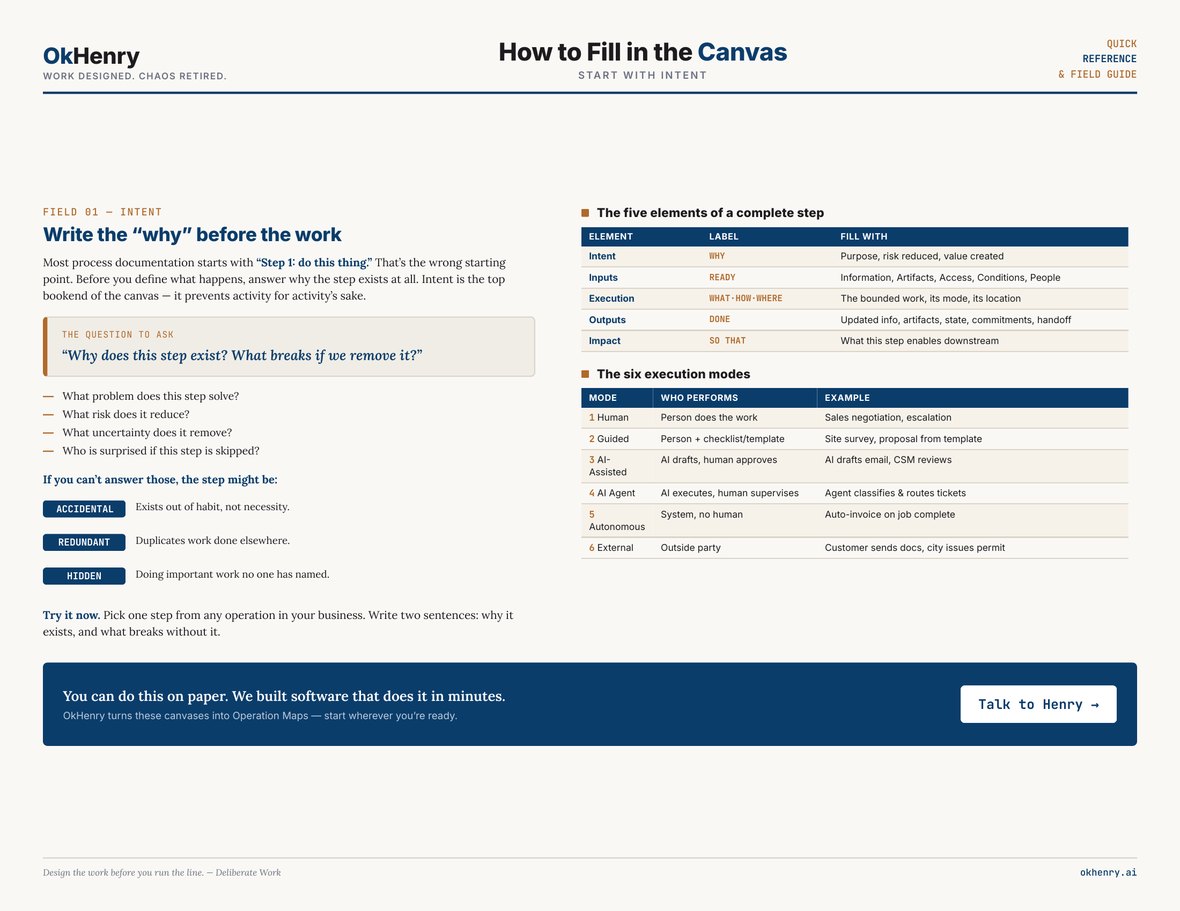
Before you define what happens, answer why the step exists at all. Intent is the top bookend of the canvas — it prevents activity for activity’s sake.

The question to ask
“Why does this step exist? What breaks if we remove it?”

If you can’t answer that, the step might be:

ACCIDENTAL
Exists out of habit, not necessity.
REDUNDANT
Duplicates work done elsewhere.
HIDDEN
Doing important work no one has named.
Page two of the canvas: a field guide explaining how to write Intent, plus quick references for the five elements and six execution modes. Page 2 · Field guide

Do it on paper. Or in minutes.

Print the canvas and run it by hand — or let Henry turn your steps into Operation Maps. Start wherever you’re ready.